A Sarasota dermatologist ranks first for "Botox near me." A Lakewood Ranch HVAC company owns the top spot for "AC repair." Both spend heavily on SEO. Both are losing customers to searches that never leave Google.
Why Local Businesses Are Losing Customers to AI Search And Don't Even Know It
Google now answers searches before anyone clicks through, and most businesses have no idea it's happening to them.
Recommendations reflect the recommender's genuine experience. Community members may earn giveaway entries for participating.

Top Recommends(123) 456-7890
View Profile Featured business

Top Recommends
Community Media · Bradenton
In this article
It is not that someone else outranked them. It is that Google answered the question on the results page and the searcher never clicked anywhere at all.
This is the shift most business owners have not yet noticed, and the ones who have noticed it often assume there is nothing they can do. Neither assumption is true. The shift is real, it is accelerating, and it shows up in your own data if you know where to look.
What Is Actually Happening on Google Search?
Google increasingly answers a search right on the results page, using an AI-generated summary, before anyone sees your listing. The feature is called AI Overviews. It pulls from websites across the internet, synthesizes an answer, and displays it at the top of the page in a gray box.
For informational searches, that means many people get what they came for without clicking. For commercial searches, the ones that used to drive phone calls and form fills, it means Google names options, describes services, sometimes quotes pricing, and leaves the searcher satisfied enough not to visit your site.
You can still rank. Your page can still be the source Google pulls from. But if the answer is on the results page, a meaningful portion of searchers stop there.
According to data from Pew Research published in January 2025, 58% of Google searches now end without a click to any website. Three years ago, that figure was 36%.
The trend is not slowing. Google continues to expand AI Overviews into more query types, and other search engines are following the same model.
Why This Matters More Than Ranking
Most businesses measure search performance by where they rank. First page, top three, number one. The assumption has always been that a higher rank means more traffic.
That assumption no longer holds in every case.
A business can rank first and receive fewer visits than it did last year at the same rank, because the percentage of searchers who click anything has dropped. The rank did not change. The behavior did.
This is why traffic can decline even when rankings stay flat or improve. It is also why many business owners, seeing stable rankings, assume their SEO is fine and attribute the traffic drop to seasonality, competition or algo updates that hit someone else.
The actual cause is structural. Google is keeping more searches on Google.
How to Tell if This Is Happening to Your Business
You do not need to guess. The data sits inside Google Search Console, the free tool Google provides to every website owner.
Open Search Console. Go to the Performance report. Set the date range to compare this quarter against the same quarter last year. Look at two numbers: total impressions and total clicks.
Impressions measure how many times your site appeared in search results. Clicks measure how many times someone actually visited. The ratio between them is your click-through rate.
If impressions are stable or rising but clicks are falling, that is the pattern. Your site is showing up. People are seeing it. They are not clicking.
The next step: filter by query. Look at your highest-impression search terms. For each one, compare clicks year over year. You will likely see certain queries where impressions stayed flat but clicks dropped by double digits. Those are the queries where Google is now answering the search before anyone reaches you.
You can also see this in Google Analytics, though the view is less direct. Compare organic search traffic year over year, then cross-reference that against your Search Console impression count. A gap between the two, where you are appearing in more searches but receiving fewer visits, tells the same story.
What Does Not Work Anymore
The traditional response to a traffic drop has been to create more content, target more keywords, build more backlinks and improve technical SEO. All of those still matter for the searches that do click through. None of them solve the problem of searches that never click at all.
You cannot out-rank a feature that sits above the rankings. You cannot out-optimize an answer box that quotes your content without sending you the visitor.
Some business owners assume Google will walk this back after complaints or regulatory pressure. That is not a strategy. Google's CEO has publicly defended AI Overviews as better for users, and usage data so far supports continued expansion, not retreat.
Waiting for the old model to return means losing ground while competitors adapt to the current one.
What Actually Works in an AI Search Environment
The businesses that are holding traffic or growing it in this environment are doing three things differently.
They optimize for the AI answer, not just the ranking
When Google pulls your content into an AI Overview, your brand name appears under the summary as a source. That is not a click, but it is visibility, and for many searches it is now the only visibility that matters.
The question is whether your content is structured in a way that makes it easy for Google to quote. That means clear headings phrased as questions, concise answers in the first sentence under each heading, and facts presented in a way that can be lifted cleanly without surrounding context.
This is not a new writing style. It is FAQ structure, applied across all content, not just a single FAQ page.
They focus on searches AI cannot fully answer
Certain searches do not resolve on the results page because they require interaction: booking, quoting, configuring, account access, local inventory check. These are the searches where clicks still happen at high rates, because the searcher needs to do something Google cannot do for them.
A dermatology practice will lose traffic on "what is Botox" but will hold traffic on "book Botox appointment Sarasota." An HVAC company will lose traffic on "how often to change air filter" but will hold traffic on "emergency AC repair near me."
Shifting content and ad spend toward high-intent, action-required queries is not a workaround. It is a reallocation toward the searches that still convert.
They build direct relationships outside of search
A person who already knows your name does not search "Botox near me." They search your business name directly, and that search almost always results in a click because the intent is navigation, not discovery.
That makes every owned channel more valuable than it was. Email lists, SMS marketing, social media, direct mail, referral programs, and local sponsorships all build the kind of top-of-mind awareness that turns a category search into a branded one.
The businesses that depend entirely on discovery through Google are the ones most exposed to this shift. The businesses that have other paths to attention are less affected.
What Google's Own Position Is
Google has acknowledged the trend but frames it as a feature, not a problem. In public statements and blog posts, the company argues that answering searches faster is what users want, and that AI Overviews increase overall search satisfaction.
The company also maintains that AI Overviews drive clicks to high-quality sources, pointing to the source links that appear below each summary. Internal data shared selectively with publishers has shown that some sites do see a lift in clicks from being featured.
What Google has not shared is the net effect. Aggregate click-through rate across all searches is not published by Google, and third-party measurement consistently shows it declining. The Pew Research figure of 58% zero-click searches is the most recent independent measure, and it is higher than any prior year on record.
For individual business owners, Google's position is less relevant than the pattern in their own data. If your clicks are down and your impressions are not, the cause is clear regardless of how Google describes it.
What a Business Owner Should Do This Week
Open Google Search Console. Run the year-over-year performance comparison described earlier. Identify which queries are showing impressions without clicks. That is your list.
For each query on that list, search it yourself and see what Google shows. If an AI Overview appears and answers the question, your content needs to be restructured around being quoted, not just ranked. If no overview appears but a featured snippet or local pack does, the same principle applies.
Next, audit your content and ad spend. Shift resources toward queries that require interaction. Stop pouring budget into informational content that ranks well but no longer converts, and start building content around the searches where people still need to visit your site to get what they came for.
Finally, measure the channels that are not search. Email open rates, referral traffic, direct traffic, social engagement. These were always important. Now they are load-bearing.
The businesses that come through this shift in strong position will be the ones who saw it early, tested quickly and adjusted their strategy before the traffic loss became a revenue problem. Most business owners are still assuming this is temporary. The data says otherwise.
Neighbors ask
AI Overviews are the gray boxes that appear at the top of some Google search results, containing an AI-generated summary that answers the query before any website links. Google pulls information from multiple sources across the web, synthesizes it into a response, and displays it directly on the search page. The feature launched broadly in 2024 and continues to expand into more query types. For many informational and commercial searches, this means users get an answer without needing to click through to any website.
Latest from the Newsroom

Share this story
Every share earns one giveaway entry.
Recommend someone
Know a business as good as Top Recommends?
Tell us who they are and why you trust them, and it could become their next feature story.
For business owners
Your business could be the next story we tell.
A written feature, a printed copy mailed to you to display, and a permanent spot in the directory.
Get featured
Free 15-minute interview.
More stories
All articles
Attractions & Entertainment · 3 min read
Oklahoma Slingshot Rentals Built a Three-Wheel Thrill Business in OKC

· 4 min read
Top Recommends Founder Craig Wallace Featured in VoyageTampa's Hidden Gems Series
Home Services · 5 min read
The H2O Heroes Brings Free Water Testing and Filtration to Sarasota and Beyond

Construction · 3 min read
Veteran Epoxy Solutions Installed More Than 100 Floors Across Tampa Bay

Dental Clinic · 3 min read
Renew Dental Loft Sees One Patient at a Time, Seven Days a Week
Photography · 3 min read
All Angles REM Built a Real Estate Media Business on One Guarantee

Art Gallery · 4 min read
Top Recommends Anna Maria Island: Alanna Kelly of Cove

Marketing · 3 min read
Kevin St John Built Businesses Before He Ever Coached One
AI & Tech · 7 min read
Claude Code: The AI That Cuts Web Development Time Without Writing Code
Non-Profit · 3 min read
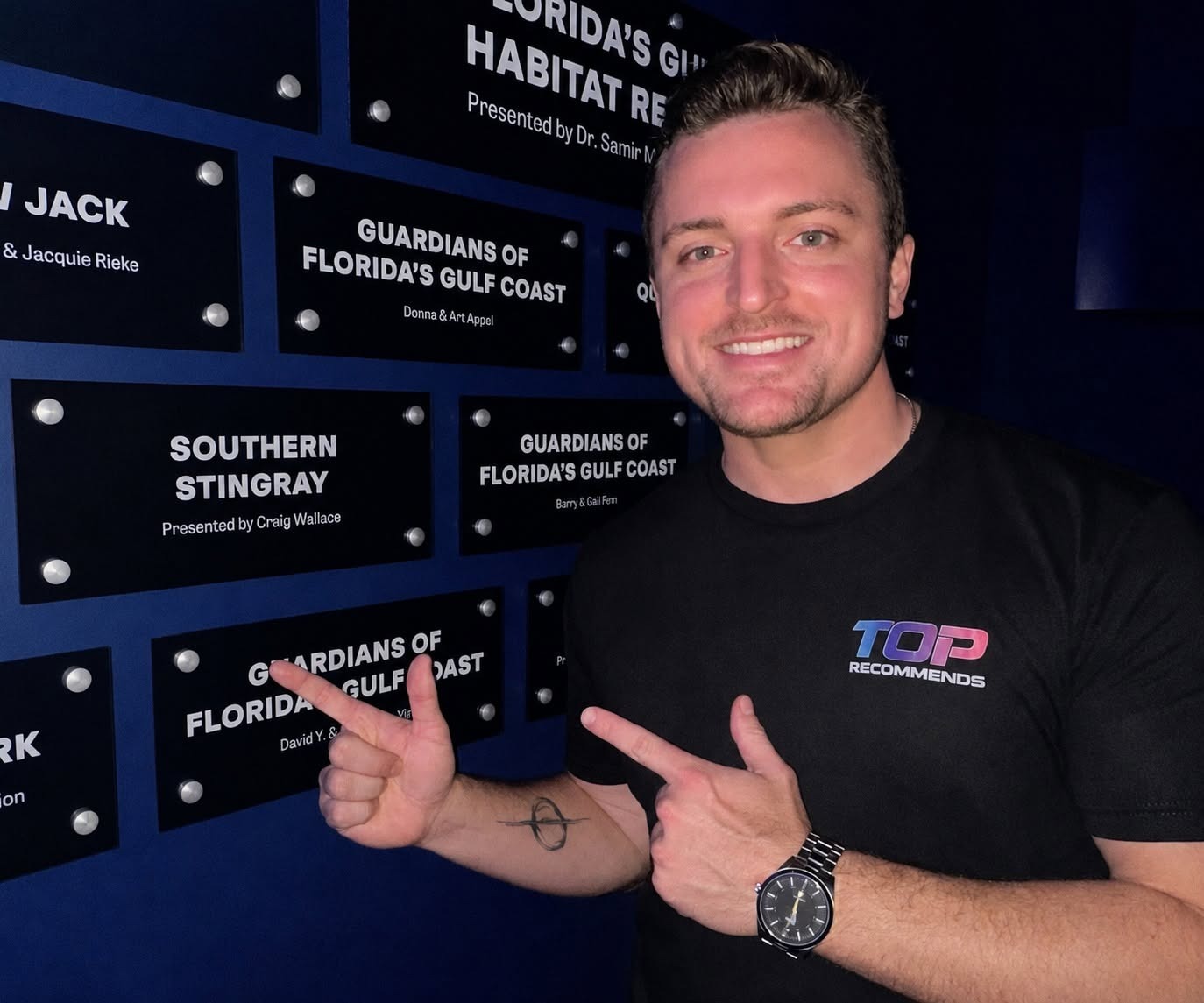
Top Recommends Pledges $50,000 to Mote Marine Laboratory & Aquarium